
A landing page is a web page built specifically to guide visitors toward one main action, such as buying a product, filling out a form, registering for a webinar, contacting the business, trying an app, or downloading materials.
At a glance, a landing page can look just like a regular website page.
But there's one big difference: a landing page isn't built so visitors explore many pages. A landing page is built so visitors take one specific action.
Imagine you see an ad that says:
"Free Website Consultation for Your Business."
You're interested and click the ad.
Ideally, you're taken straight to a page that explains that service, its benefits, portfolio, testimonials, and a button to schedule a consultation.
Not to a homepage that has a menu like:
About Us — Blog — Careers — Products — Contact — News — Gallery.
The more irrelevant options there are, the more likely visitors lose focus.
That's why landing pages are one of the key elements in digital marketing, advertising, lead generation, and conversion rate optimization.
In this article, we'll cover what a landing page is, its meaning, function, types, structure, usage examples, and how it differs from a homepage and a regular website.
Table of Contents
- What Is a Landing Page?
- What Does Landing Page Mean?
- What Is a Landing Page? A Simple Explanation
- What Does Conversion Mean on a Landing Page?
- Landing Page Function
- 1. Increasing Visitor Focus
- 2. Supporting Conversion Campaigns
- 3. Collecting Leads
- 4. Selling Products More Directly
- 5. Making Campaign Measurement Easier
- 6. Testing Marketing Messages
- Examples of Landing Page Use in Business
- Webinar Landing Page
- Product Landing Page
- Service Landing Page
- Real Estate Landing Page
- App Landing Page
- Promo Landing Page
- A Simple Landing Page Example
- Hero
- Benefit
- Price List
- Testimonial
- Service Area
- CTA
- Landing Page vs Homepage: What's the Difference?
- Landing Page vs Website
- The Structure of a Good Landing Page
- 1. Headline
- 2. Subheadline
- 3. Hero Visual
- 4. Call-to-Action
- 5. Benefit
- 6. Social Proof
- 7. FAQ
- 8. Final CTA
- Anatomy of a Landing Page in Simple Form
- Why Is a Landing Page Important for Digital Marketing?
- The Relationship Between Landing Pages and Google Ads
- A Landing Page Must Be Mobile-Friendly
- Is a Landing Page Good for SEO?
- Landing Pages and SEO Topic Clusters
- How Do You Build a Landing Page?
- 1. Define the Conversion Goal
- 2. Define the Audience
- 3. Define the Value Proposition
- 4. Build the Structure
- 5. Design Mobile-First
- 6. Build the Page
- 7. Set Up Analytics
- 8. Test
- Common Landing Page Mistakes
- Too Many CTAs
- Unclear Headline
- Too Many Form Fields
- No Proof
- Not Mobile-Friendly
- When Should a Business Use a Landing Page?
- Does a Small Business Need a Landing Page?
- FAQ About Landing Pages
- What does landing page mean?
- What does landing page mean?
- What's the function of a landing page?
- What's the difference between a landing page and a website?
- What's the difference between a landing page and a homepage?
- Does a landing page need to have a form?
- Does a landing page need to be without a menu?
- Can a landing page be used for SEO?
- What's a good landing page conversion rate?
- Is a landing page required to be mobile-friendly?
- Can WordPress be used to build a landing page?
- Conclusion
What Is a Landing Page?

A landing page is a destination page someone visits after clicking a link or campaign, designed to drive one specific conversion goal.
That conversion can be:
- a purchase;
- a sign-up;
- filling out a form;
- booking a consultation;
- a reservation;
- an app download;
- an e-book download;
- a quotation request;
- clicking WhatsApp;
- a software trial;
- a newsletter subscription.
Google Ads itself defines a landing page simply as the web page someone arrives at after clicking an ad.
But in digital marketing practice, a landing page is usually designed more specifically than just an ordinary destination page.
The page needs to continue the context the user previously saw.
For example, someone clicks an ad:
"Company Profile Website Starting from RpX Million."
Then the landing page should ideally go straight into:
- the company profile development service;
- what you get;
- website examples;
- the work process;
- cost estimate;
- a consultation CTA.
Not sending users to a general homepage with no context.
Google also explicitly recommends that a landing page have a close relationship with the ad and keyword that brought users to it, since the landing page's relevance and usefulness are part of the landing page experience evaluation in Google Ads.
What Does Landing Page Mean?
Linguistically, landing means "to land," while page means "page."
So the literal meaning of landing page is:
the page where a visitor lands.
The term arose because someone usually arrives at a landing page after taking some previous action.
For example:
Google Search → click an ad → landing page
or:
Instagram Ads → click a CTA → landing page
or:
email marketing → click a promo → landing page
or:
TikTok → click the bio link → landing page
Since users already have context before arriving, a landing page should continue that message.
This is the concept often called message match.
If an ad says:
20% off shoes.
But once clicked, the page instead shows a general clothing catalog, users will feel they haven't found what they expected.
Google Ads even treats the match between ad, keyword, and destination page as one of its main recommendations for improving landing page experience.
What Is a Landing Page? A Simple Explanation
If you're still asking what a landing page is, picture a salesperson who only has a few minutes to convince a prospective customer.
That salesperson won't explain the company's entire history from the start.
They'll focus on:
- the prospect's needs;
- the solution being offered;
- the benefit;
- the proof;
- the next action.
A landing page works on a similar principle.
That's why a landing page's structure usually looks like:
Headline → Value Proposition → Benefit → Social Proof → Explanation → CTA
Not:
Homepage → Menu → News → About the Company → Gallery → Dozens of Links.
What Does Conversion Mean on a Landing Page?
You'll often come across the word conversion when learning about landing pages.
Conversion is when a user takes the action that is the actual goal of the page.
For example, a landing page gets:
1,000 visitors
and:
70 people fill out the consultation form.
Then its conversion rate is:
70 ÷ 1,000 × 100 = 7%
But a good conversion rate figure heavily depends on the industry, traffic source, offer, product price, and how conversion is defined.
As a reference, an Unbounce benchmark based on more than 41,000 landing pages, 464 million pageviews, and 57 million conversions found a cross-industry median conversion rate of around 6.6%.
That figure should be treated as a general benchmark, not a universal target.
SaaS, real estate, e-commerce, professional service, and webinar landing pages naturally have different conversion characteristics.
Landing Page Function
Broadly speaking, a landing page's function is to turn traffic into an action that has value for the business.
But when broken down further, a landing page serves several important functions.
1. Increasing Visitor Focus
A homepage usually has many goals.
Visitors can:
- read the company profile;
- view products;
- open the blog;
- check the portfolio;
- read job openings;
- view the address;
- contact the company.
A landing page narrows those options down.
For example:
Download the Free Guide
The entire page is then directed at helping visitors understand why the guide is useful and ultimately download it.
2. Supporting Conversion Campaigns
Landing pages are often used in:
- Google Ads;
- Meta Ads;
- TikTok Ads;
- email marketing;
- affiliate campaigns;
- influencer campaigns;
- SEO;
- webinars;
- events;
- product launches.
The goal is to make sure the traffic already obtained doesn't stop at just a visit.
Google states that landing pages play a major role in turning ad clicks into customers, and a landing page that matches the ad and keyword can help make the user experience more relevant.
3. Collecting Leads
One of the most common landing page functions is lead generation.
For example, a software house has a landing page:
Consult Us About Your App Idea
Visitors then fill in:
- name;
- email;
- WhatsApp number;
- project needs.
That data becomes a lead the sales team can follow up on.
4. Selling Products More Directly
A landing page can also be used for direct selling.
For example:
Skincare landing page → benefit → ingredients → testimonial → price → buy CTA
or:
Course landing page → curriculum → instructor → testimonial → price → sign up
Unlike an online store with dozens of products, this page focuses on selling one product or one campaign.
If your business needs a more complete commerce website, a landing page approach can be combined with a online store website structure.
5. Making Campaign Measurement Easier
Since it usually has a single conversion goal, a landing page's performance is relatively easy to measure.
Some commonly monitored metrics include:
- visitors;
- conversions;
- conversion rate;
- bounce or engagement;
- form completion;
- CTA click-through rate;
- cost per lead;
- cost per acquisition;
- revenue per visitor.
This lets the business know whether a campaign is truly producing an outcome.
6. Testing Marketing Messages
A landing page is also very useful for experimentation.
For example, a business wants to know which headline is more effective:
Version A
HR Software for Modern Companies
Version B
Manage Attendance, Payroll, and Employee Leave in One System
Both can be tested using A/B testing.
The same can be done for:
- CTA;
- hero image;
- form;
- price;
- testimonials;
- page length;
- offer.
Examples of Landing Page Use in Business
To make it easier to understand what a landing page means, here are a few usage examples.
Webinar Landing Page

Its goal is getting sign-ups.
Structure:
Webinar headline → date → speaker → material → benefit → form → register CTA
Product Landing Page
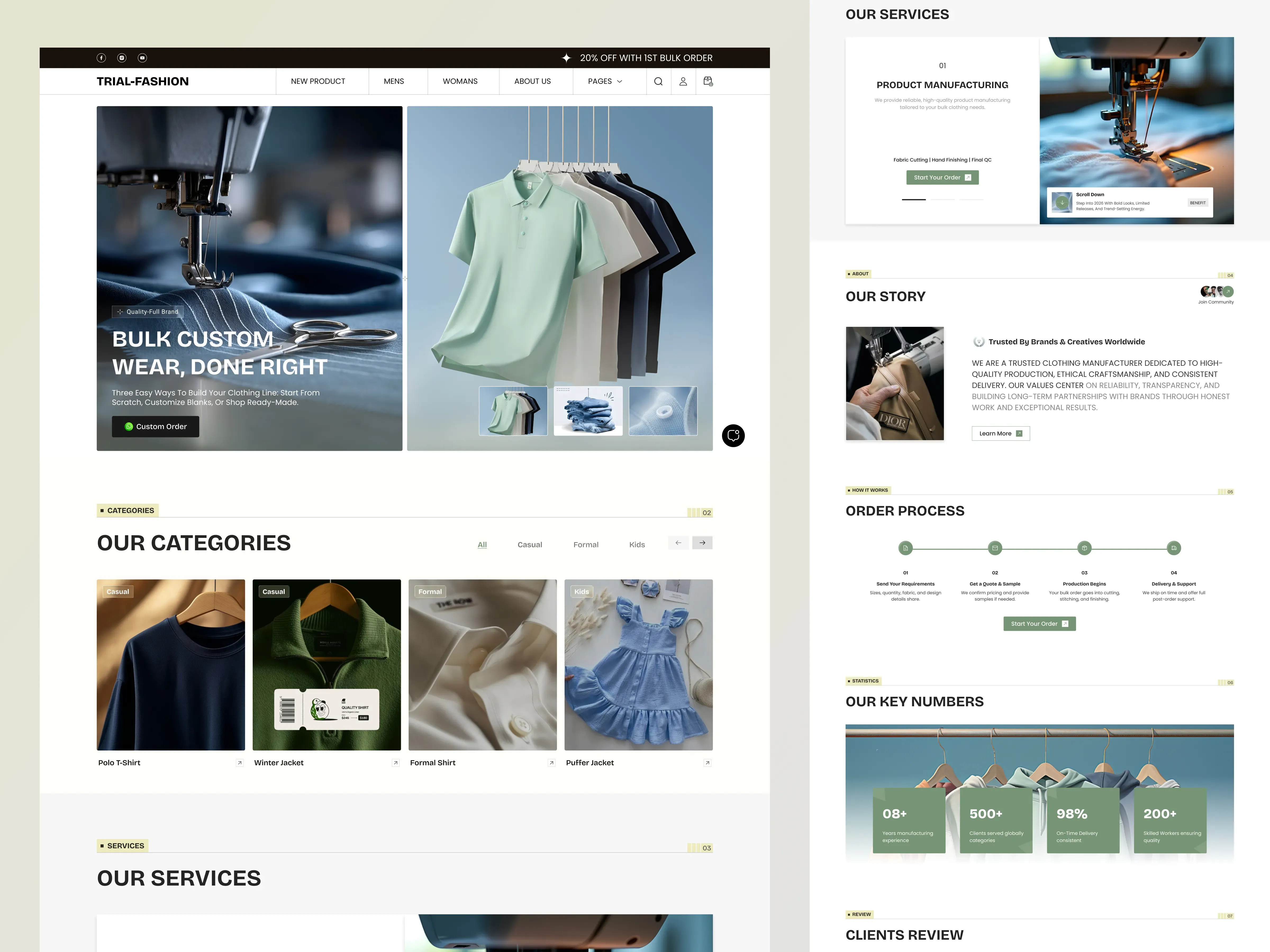
Its goal is getting sales.
Structure:
Problem → product → benefit → proof → testimonial → price → buy CTA
Service Landing Page

Its goal is generating leads.
Structure:
Headline → problem → solution → portfolio → process → testimonial → consultation
A business like web development, for example, can use a landing page to promote a specific service before directing prospective customers to the website development services page.
Real Estate Landing Page
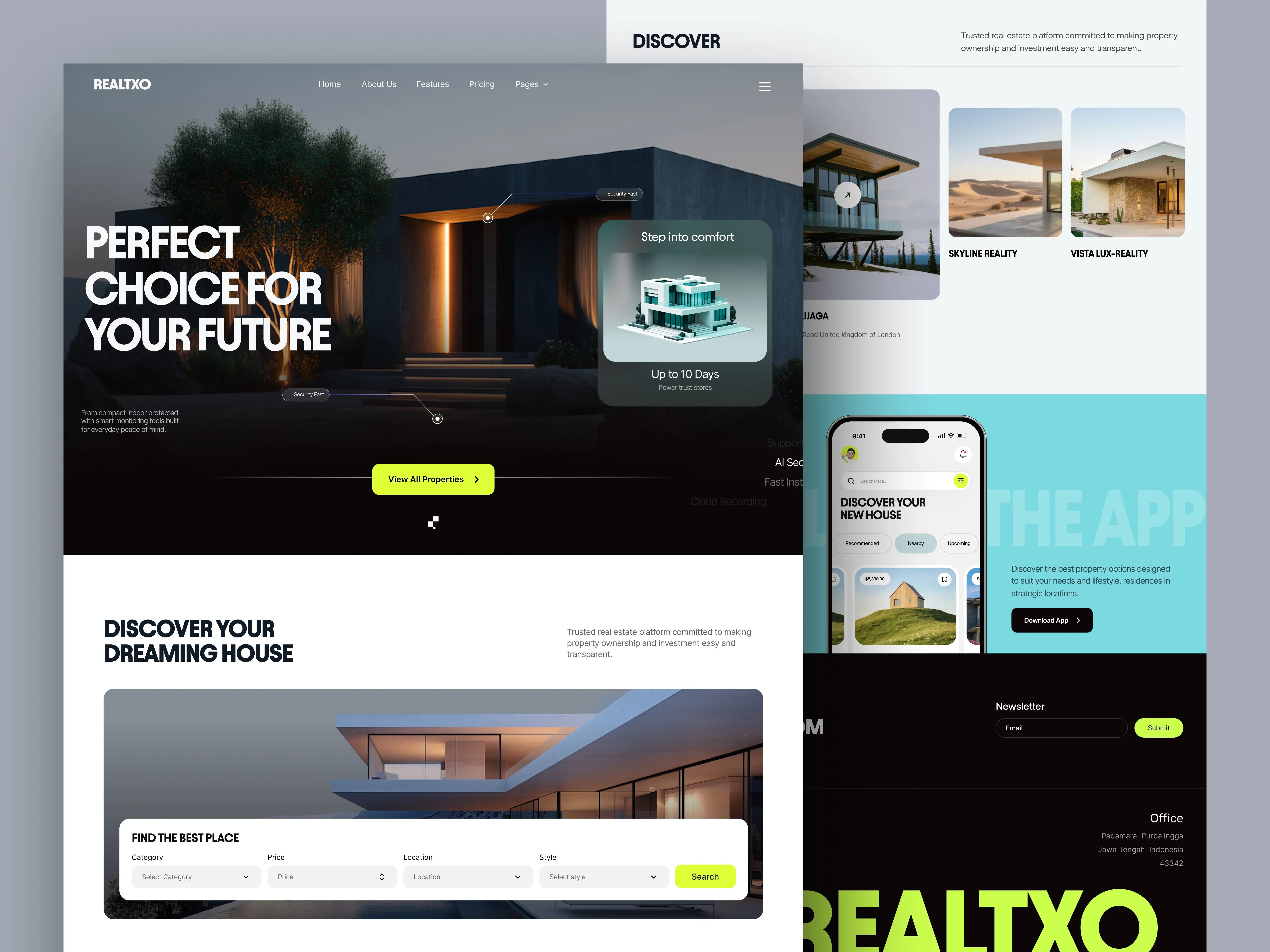
Its goal is getting inquiries.
Information usually includes:
- property photos;
- price;
- specifications;
- facilities;
- location;
- floor plan;
- developer;
- a survey CTA.
App Landing Page

Its goal is getting downloads or sign-ups.
It usually shows:
- app screenshots;
- benefits;
- features;
- rating;
- testimonials;
- App Store / Google Play CTA.
Promo Landing Page

For example, a campaign:
40% Ramadan Promo
Users don't need to read through the entire company website.
The landing page just needs to explain:
- the promo;
- the period;
- the product;
- the mechanics;
- the terms;
- the CTA.
A Simple Landing Page Example
A landing page doesn't have to be long.
For local businesses, a simple format is often already enough.
For example, a laundry business in Bandung:
Hero
Pickup & Delivery Laundry in Bandung, Starting from Rp7,000/kg
Clean clothes without having to leave the house.
[Order via WhatsApp]
Benefit
- pickup and delivery;
- fast turnaround;
- transparent pricing.
Price List
Show the price.
Testimonial
Show a review.
Service Area
Bandung and surrounding areas.
CTA
Order Laundry Now
Done.
It doesn't need 15 sections.
If your business targets a local market, the same approach can be combined with regional pages like website development services Bandung or website development services Jakarta.
Landing Page vs Homepage: What's the Difference?
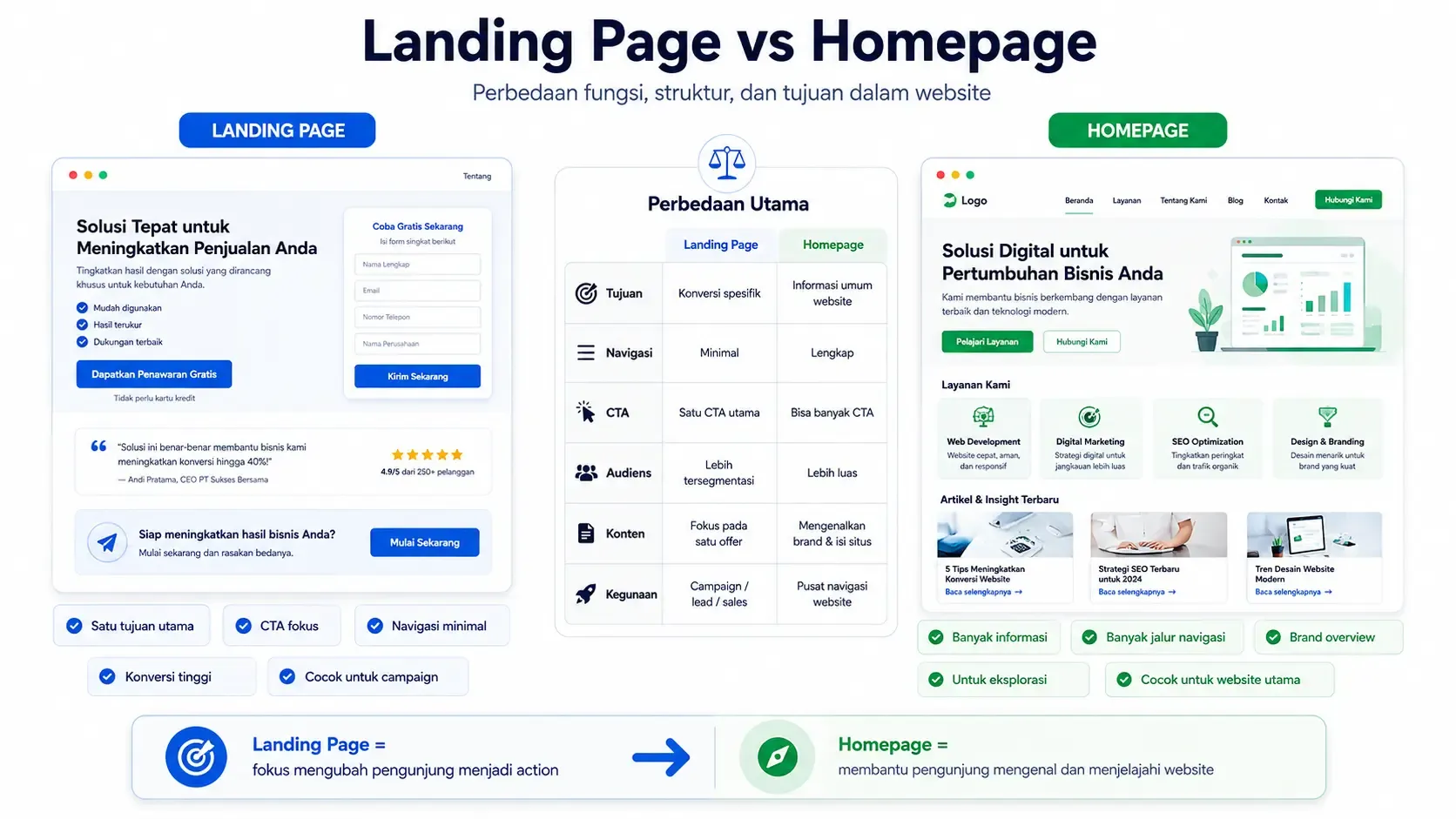
A landing page and a homepage are often thought to be the same since both are web pages.
But their goals are different.
Element | Landing Page | Homepage |
|---|---|---|
Goal | Specific conversion | Introduce the whole website |
Navigation | Minimal | Complete |
CTA | Usually one main | Can be many |
Target audience | More specific | Broader |
Traffic source | Specific campaign/search | Varied |
Content | Focused on one offer | Many categories |
Measurement | Conversion oriented | Navigation & discovery |
For example, a web agency's homepage might have:
Home — About — Services — Portfolio — Blog — Contact
While its landing page might only discuss:
Company Profile Website Development Service
and its entire content focuses on that one service.
To understand the website ecosystem more broadly, you can also read our guide on how to build a website.
Landing Page vs Website
The question "is a landing page the same as a website?" also comes up very often.
The answer:
Not entirely the same.
A website is a collection of interlinked pages.
For example:
Homepage
├── About Us
├── Services
├── Portfolio
├── Blog
└── Contact
While a landing page can stand on its own as one dedicated page:
Landing Page Campaign
├── Hero
├── Benefit
├── Social Proof
├── Offer
└── CTA
A landing page is still part of the web, but its function and architecture are more focused.
The Structure of a Good Landing Page
There's no single structure that must be used.
But most effective landing pages have the following elements.
1. Headline
The headline must answer:
What's being offered?
Example:
Build a Professional Website for Your Business.
It's even better if it explains the outcome:
Turn Website Visitors into Prospective Customers.
2. Subheadline
The subheadline gives additional detail.
Example:
The website is designed to fit your business needs, responsive across all devices, and ready to support your digital marketing.
3. Hero Visual
The visual can be:
- product screenshot;
- product photo;
- app mockup;
- portfolio;
- demo video;
- service photo.
Use a visual that explains the offer, not just decoration.
4. Call-to-Action
A CTA tells users the next action.
CTA examples:
- Try for Free
- Order Now
- Schedule a Consultation
- Download the Guide
- View Pricing
- Register for the Webinar
A CTA like Submit or Click Here usually provides less context.
5. Benefit
Explain the outcome, not just the feature.
Feature:
Real-time dashboard.
Benefit:
Monitor your business performance without waiting for a manual report.
6. Social Proof
Social proof helps build trust.
For example:
- testimonials;
- client logos;
- reviews;
- ratings;
- number of users;
- case studies;
- campaign results.
7. FAQ
FAQs are useful for reducing hesitation before users convert.
For example:
- how long does the process take?
- are there any extra fees?
- how does payment work?
- is a refund possible?
- is support available?
8. Final CTA
Visitors who've read all the way to the bottom usually have higher intent.
So repeat the CTA at the end of the page.
Anatomy of a Landing Page in Simple Form
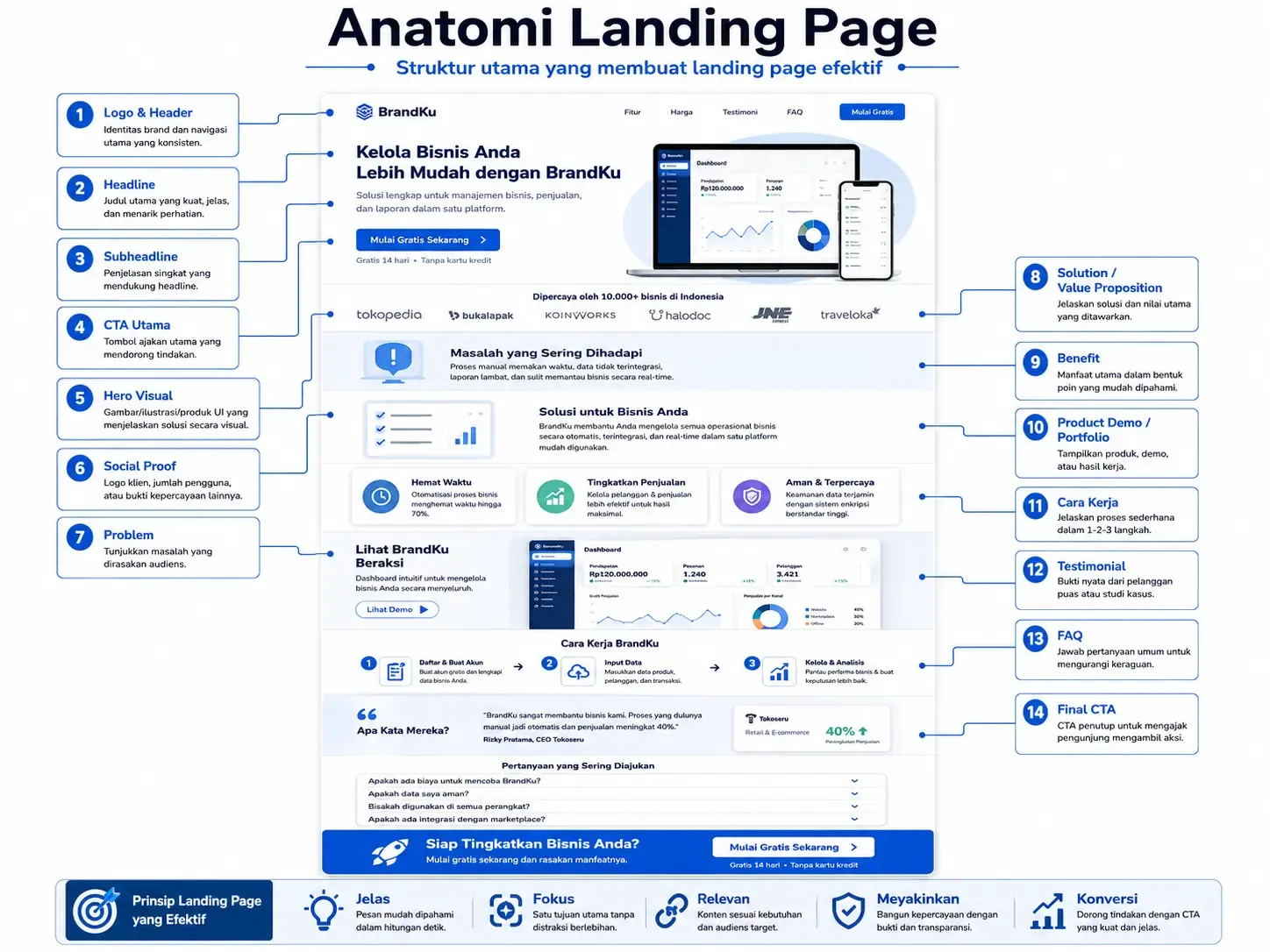
The basic structure can be pictured like this:
LOGO

HEADLINE
Subheadline

[ CTA ]

HERO IMAGE
------------------------

SOCIAL PROOF
------------------------

PROBLEM
------------------------

SOLUTION
------------------------

BENEFIT

Benefit 1
Benefit 2
Benefit 3
------------------------

PRODUCT DEMO
------------------------

HOW IT WORKS
1 → 2 → 3
------------------------

TESTIMONIAL
------------------------

FAQ
------------------------

FINAL CTA
If you want to see various visual implementations, we've compiled inspiring landing page examples from SaaS, F&B, real estate, SMEs, services, portfolios, and even e-commerce.
Why Is a Landing Page Important for Digital Marketing?
Imagine a company spending Rp10 million on Google Ads.
The ad is compelling.
CTR is good.
Traffic comes in.
But everything is directed to a homepage with dozens of menus.
Visitors then have to search on their own for the product they previously saw in the ad.
Some succeed.
Others leave.
The problem isn't the ad.
The problem is the lost continuity after the click.
Google Ads itself explains that users expect the destination page to be relevant to the ad message they clicked.
That's why a landing page functions as the connector between:
Intent → Click → Information → Trust → Action
The more friction along that path, the harder it is for conversion to happen.
The Relationship Between Landing Pages and Google Ads
A landing page has a direct impact on the Google Ads campaign experience.
Google states that Quality Score has three diagnostic components:
- expected CTR;
- ad relevance;
- landing page experience.
Landing page experience evaluates whether the page is useful and relevant to the person who clicked the ad.
That's why when building a campaign:
keyword → ad → landing page
all three should speak to the same intent.
A poor example:
Keyword: online store website service
Ad: Build a Professional Online Store
Landing page: generic agency homepage
A more relevant example:
Keyword: online store website service
Ad: Build a Professional Online Store
Landing page: a dedicated page for online store development services
You can see that approach on our online store website development services page.
A Landing Page Must Be Mobile-Friendly
When building a landing page, don't design for desktop first then just shrink the layout for mobile.
Google recommends making sure a landing page is mobile-friendly, especially since many prospective customers access websites through mobile devices.
Some things to pay attention to:
- buttons are easy to tap;
- the font is easy to read;
- the form isn't too long;
- the layout doesn't scroll horizontally;
- the hero isn't too tall;
- the CTA appears relatively quickly;
- images are compressed;
- the page loads fast.
Google has also noted that, in a retail context, a delay of around one second on mobile devices can significantly impact conversion.
This means performance isn't just a developer's concern.
Speed is part of the conversion experience.
Is a Landing Page Good for SEO?
Yes.
A landing page doesn't always have to be used for paid advertising.
A landing page can also be built for organic search.
For example, a user searches for:
- website development services Jakarta;
- website services Bandung;
- website services for SMEs;
- company profile website services.
Instead of directing all those keywords to the homepage, a business can have a landing page that specifically answers each intent.
For example:
- website development services Jakarta;
- website development services Bandung;
- website services for SMEs;
- company profile website services.
But an approach like this local SEO must be done with quality.
Don't create 50 city pages with identical content that only swap out the city name.
A good local landing page should be genuinely relevant to the target area.
Landing Pages and SEO Topic Clusters
A landing page can also be part of a topic cluster.
For example, an AltiveDev cluster can have this structure:
Pillar Topic: Website
↓
Landing Page
↓
Supporting content:
- what is a landing page;
- landing page examples;
- how to build a website;
- business website;
- HTML;
- WordPress;
- online store website;
- web development.
With natural internal linking, search engines get stronger context about how topics relate to each other.
Readers also get a clear learning path.
If you want to understand the technical side of building a website, continue to the guide:
- how to build a website with HTML;
- how to build a website with WordPress;
- or understand what web development is.
How Do You Build a Landing Page?
Broadly speaking, the process consists of:
1. Define the Conversion Goal
Example:
getting a consultation.
Don't start with the design.
Start with the objective.
2. Define the Audience
Who's going to visit?
What's their problem?
What are they looking for?
3. Define the Value Proposition
Why should they choose you?
4. Build the Structure
For example:
Hero → Problem → Solution → Benefit → Proof → CTA
5. Design Mobile-First
Prioritize the smartphone layout from the start.
6. Build the Page
A landing page can be built using:
- HTML/CSS/JavaScript;
- WordPress;
- a website builder;
- a framework;
- a CMS;
- an AI website builder.
For beginners, some related guides worth checking out are how to build your own website as a beginner or how to build a website with AI.
7. Set Up Analytics
At minimum, track:
- pageview;
- CTA click;
- form submit;
- purchase;
- WhatsApp click.
8. Test
Test:
- headline;
- CTA;
- offer;
- form;
- pricing;
- social proof.
A landing page rarely becomes perfect on its first version.
Common Landing Page Mistakes
Too Many CTAs
For example, in one hero section:
Buy
Download
Register
Follow
Read the Blog
Contact Us
Users don't know which is the main action.
Unclear Headline
Example:
Empowering Your Digital Future.
Sounds appealing but doesn't explain the product.
Compare:
Build a Professional Business Website Without Managing the Technical Side Yourself.
Much clearer.
Too Many Form Fields
If you only need a WhatsApp number for follow-up, don't ask for 15 pieces of information.
Every field adds effort.
No Proof
Claim:
The best agency.
Doesn't mean much without proof.
It's better to show:
- projects;
- case studies;
- testimonials;
- clients;
- results.
Not Mobile-Friendly
The hero looks great on desktop, but the CTA only appears after a long scroll on mobile.
This often happens when a desktop design is simply shrunk down.
When Should a Business Use a Landing Page?
A landing page is very useful when you're:
- running ads;
- launching a product;
- offering a promo;
- collecting leads;
- holding an event;
- taking pre-orders;
- testing an MVP;
- wanting to promote one service;
- targeting a local keyword;
- building a waiting list.
A startup still testing an idea can even use a landing page before building the full product.
In this context, a landing page can be one of the initial validation tools before developing a Minimum Viable Product, or MVP.
Does a Small Business Need a Landing Page?
Not every business needs a landing page.
But a small business can gain a lot of benefit if it has one product or service it wants to promote in a focused way.
For example:
An SME selling catering.
Instead of running Instagram Ads to a homepage full of company information, the campaign can be directed to a page:
Office Catering Packages Jakarta
Contents:
- menu;
- price;
- minimum order;
- delivery area;
- testimonials;
- WhatsApp.
If you're building a digital presence from scratch, also read our guide on how to build a business website.
FAQ About Landing Pages
What does landing page mean?
A landing page is a web page designed to receive traffic from a source and direct it toward one conversion goal, such as a purchase, sign-up, form submission, or consultation.
What does landing page mean?
Literally, landing page means the page where a visitor "lands" after clicking a link, such as an ad, email, social media, or a search result.
What's the function of a landing page?
The function of a landing page is to turn traffic into an action that has value, such as a lead, sign-up, sale, download, or booking.
What's the difference between a landing page and a website?
A website consists of many pages and usually serves several purposes. A landing page is usually more focused on one offer and one main action.
What's the difference between a landing page and a homepage?
A homepage acts as a website's main entry point and has a lot of navigation. A landing page usually reduces distraction and focuses on one conversion goal.
Does a landing page need to have a form?
No.
A form is only needed when the conversion goal requires user data.
An e-commerce landing page, for example, can go straight to a Buy Now CTA.
Does a landing page need to be without a menu?
Not necessarily.
But campaign landing pages often reduce navigation so users' attention isn't split.
For an evergreen SEO page, navigation can still be used as long as it doesn't get in the way of conversion.
Can a landing page be used for SEO?
Yes.
A landing page can target keywords for a product, service, category, or location, as long as the content is relevant and provides value to users.
What's a good landing page conversion rate?
There's no universal number.
Unbounce's benchmark based on more than 41,000 landing pages found a cross-industry median conversion rate of around 6.6%, but performance should be compared against the same industry and conversion type.
Is a landing page required to be mobile-friendly?
Highly recommended.
Many users access the internet through smartphones, so a landing page's CTA, form, layout, typography, visuals, and performance must stay comfortable to use on a small screen.
Can WordPress be used to build a landing page?
Yes.
WordPress is one of the platforms commonly used to build landing pages and websites. You can learn the basic steps through our guide on how to build a website with WordPress.
Conclusion
So, a landing page is a web page built to take a visitor from an intent to one main action.
Visitors might come from:
Google Ads.
Instagram.
SEO.
Email.
TikTok.
WhatsApp.
But once they're on the landing page, the question is always the same:
Does this page help users understand what's being offered and make it easy for them to take action?
An effective landing page generally has:
- a clear headline;
- a strong value proposition;
- relevant visuals;
- one main CTA;
- an easy-to-understand benefit;
- social proof;
- a logical information structure;
- a good mobile experience;
- adequate page speed;
- message match with the traffic source.
A landing page isn't just a page that looks good.
A landing page is the bridge between attention and action.
Ads, SEO, social media, or email can bring people to the door.
But it's the landing page that helps determine whether they just look around—or ultimately become a lead and a customer.
If, after understanding the concept, you want to see it applied visually, continue to the guide on inspiring landing page examples to see various landing page structures by business type.


Comments
Got a question or feedback? Leave a comment!