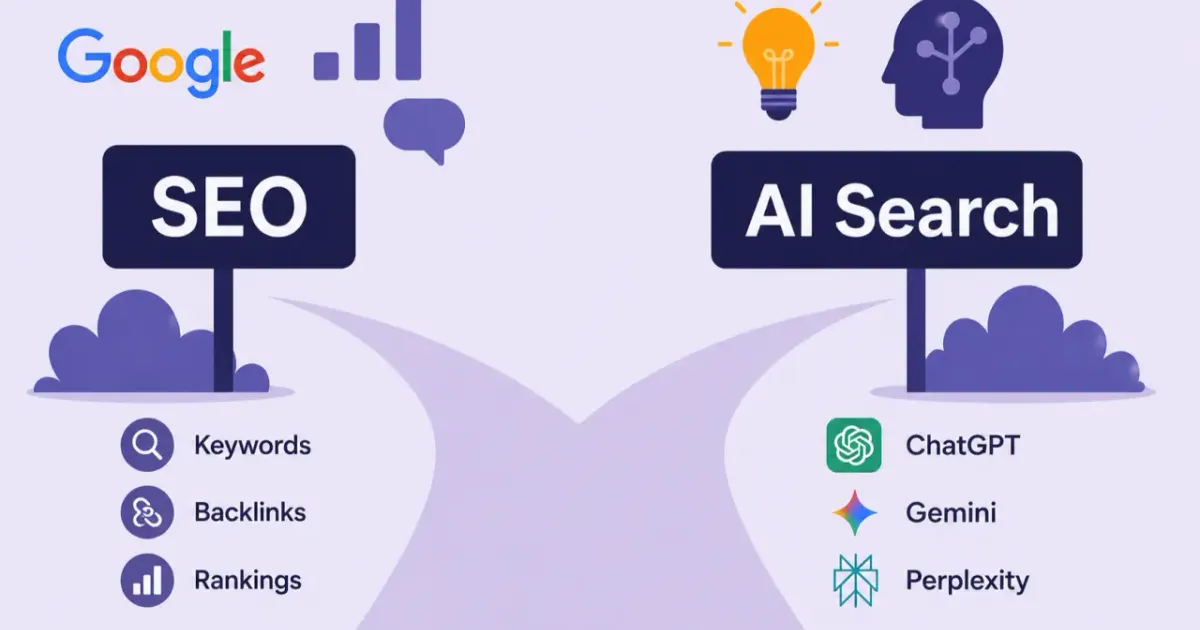
AI brand visibility can't be measured just by checking whether your website ranks on Google's first page. A brand can hold a strong organic position but still be rarely mentioned, cited, or recommended in answers from ChatGPT, Gemini, Perplexity, and other AI search platforms.
In Search Engine Journal's guide on how to measure brand visibility in AI answers, Lauren Parker from HubSpot offers an audit framework focused on prompts, mentions, recommendations, share of voice, gap analysis, and source mix. The article is a HubSpot sponsored post, so claims about product performance and HubSpot's case studies should be understood as data provided by the sponsor, not an independent industry benchmark.
Even so, the measurement framework is useful for SEO teams because it forces us to stop treating AI search like a traditional SERP. The main question is no longer just "what's my ranking?" but "how often does the brand appear, how often is it recommended, and which sources make the model choose that brand?"
Table of Contents
- What Is AI Brand Visibility?
- Why a High SEO Ranking Doesn't Guarantee a Brand Appears in AI?
- What's the Difference Between Mentions, Recommendations, Citations, and Share of Voice?
- How Do You Run Your First AI Visibility Audit?
- Why Do Keywords Need to Become Prompts?
- How Do You Collect AI Answer Data Consistently?
- How Do You Calculate Mention Rate?
- How Do You Calculate Recommendation Rate?
- How Do You Calculate Share of Voice in AI Search?
- Why Should Each AI Engine Be Measured Separately?
- What Is a Gap List in an AI Visibility Audit?
- What Is Source Mix, and Why Does It Matter So Much?
- How Do You Fix AI Visibility Once a Gap Is Found?
- 1. Fix your profile on review directories
- 2. Audit the online communities that get cited often
- 3. Update third-party roundups
- 4. Make your website easier to cite
- Does Your Own Website Still Matter for AI Visibility?
- How Do You Connect AI Visibility to Revenue?
- How Do You Build a Simple AI Visibility Dashboard?
- Can HubSpot's Numbers in the Article Be Used as a Benchmark?
- What Are the Common Mistakes When Measuring AI Visibility?
- FAQ About AI Brand Visibility
- What are the main metrics for measuring AI brand visibility?
- Does a high Google ranking guarantee a brand appears in ChatGPT?
- How many times should a prompt be tested?
- Is a brand mention the same as a citation?
- Does AI visibility need to be measured on every platform?
- Do you need a paid tool?
- Conclusion
What Is AI Brand Visibility?
AI brand visibility is a measure of how often and how strongly a brand appears in answers generated by AI systems for prompts relevant to its business. Visibility can take the form of mentions, recommendations, citations, position within the answer, and share of voice compared to competitors.
This concept is related to search engine optimization, but what's being measured is different. Traditional SEO largely measures URL position in search results. AI visibility focuses more on how the brand is represented within a synthesized answer.
The difference matters because users can get a complete answer without ever visiting a website. In this zero-click scenario, a brand mention or recommendation can still hold value even when no organic session occurs.
Why a High SEO Ranking Doesn't Guarantee a Brand Appears in AI?
Because traditional SERPs and AI answers assemble results through different mechanisms. Search engines select and rank pages, while an AI answer composes a new response using information from several sources it considers relevant and authoritative.
The SEJ article explains that AEO, or Answer Engine Optimization, doesn't replace SEO. Technical health, site structure, schema, and content quality remain the foundation. But AI visibility is also shaped by coverage across the wider web and the source mix the engine uses to form its answer.
For example, your product page might rank third for the query "CRM software for small businesses." But when a user asks an AI, "Which CRM works best for a 20-person sales team on a tight budget?", the system may rely more heavily on review directories, forums, comparison articles, or other sources than on your landing page.
So URL ranking and brand recommendation aren't the same thing.
What's the Difference Between Mentions, Recommendations, Citations, and Share of Voice?
Metric | Meaning | Why It Matters |
|---|---|---|
Mention | The brand is named in an AI answer | Measures the brand's basic presence |
Recommendation | The brand is explicitly included as an option worth considering | Closer to purchase intent |
Citation | A page or domain is used as the source of the answer | Shows which evidence sources the engine trusts |
Share of Voice | The brand's share of mentions relative to all brands that appear | Measures relative standing against competitors |
The difference between a mention and a recommendation matters a lot. A brand can be mentioned often but recommended rarely. In a commercial-intent context, a recommendation is usually closer to the moment a user is building a shortlist.
How Do You Run Your First AI Visibility Audit?
The framework SEJ describes starts with commercial queries that already have solid SEO performance, then turns them into natural prompts phrased the way a buyer would ask.
- Export commercial-intent queries from Google Search Console. Focus on keywords with an average position of 10 or better.
- Pick queries that carry purchase intent. Think "best," "software," "tool," "platform," "vs," "alternative," "pricing," or a category name.
- Turn the keyword into a natural question. Add context such as company size, industry, budget, or the job the user is trying to get done.
- Build a prompt-tracking spreadsheet. Every prompt should have an identifier and an intent category.
- Run the prompt across several AI engines. Compare ChatGPT, Gemini, Perplexity, or other relevant platforms.
- Record which brands and citations show up. Don't just log whether your own brand appeared.
- Calculate visibility metrics. Use mention rate, recommendation rate, and share of voice.
Why Do Keywords Need to Become Prompts?
Because the way people talk to AI is usually very different from how they type a short query into a search engine.
Keyword:
best CRM small businessCan turn into the prompt:
Which CRM works best for a services company with 20 salespeople,
a tight budget, and a need for WhatsApp integration?
The second prompt carries far clearer constraints. The AI has to weigh business size, budget, use case, and integration needs before recommending a product.
This is why keyword ranking can't be mapped one-to-one onto AI answer visibility. A single commercial keyword can branch into dozens of prompt variations depending on the buyer's context.
How Do You Collect AI Answer Data Consistently?
The SEJ article recommends running prompts under conditions that minimize personalization — for example, using a temporary chat, incognito mode, or a session unaffected by account history.
Each prompt should be run more than once, since generative AI answers are probabilistic. In that framework, a prompt is run two or three times and the answer that appears most often is used as the representative result.
For each prompt, log at minimum:
- The AI engine used.
- Which brands are mentioned.
- The order brands appear in the answer.
- Whether your brand appears at all.
- Whether your brand makes the first three names.
- Which domains are cited as sources.
For a more mature internal audit, you can also add timestamp, country, language, model/version (if visible), sentiment, claim accuracy, and intent type.
How Do You Calculate Mention Rate?
Mention rate measures how often your brand appears across all the prompts you tested.
Mention Rate =
Number of prompts that mention the brand
÷
Total prompts tested
× 100%
Example: you test 100 prompts and the brand appears in 42 answers.
42 ÷ 100 × 100% = 42%Your mention rate for that dataset is 42%.
This metric is simple, but it doesn't tell you whether the brand was only mentioned in passing or actually recommended.
How Do You Calculate Recommendation Rate?
The framework in the SEJ article uses a top-three appearance as a proxy for recommendation rate. In other words, a brand is considered to have stronger recommendation visibility when it appears among the first three brands named.
Recommendation Rate =
Number of prompts with the brand in the top 3
÷
Total prompts tested
× 100%
For example, out of 100 prompts, the brand lands in the top three in 18 answers:
18 ÷ 100 × 100% = 18%Note that this is an operational definition from the article's framework, not a universal industry standard. Teams can adjust the definition of "recommendation" based on answer format and their own business needs.
How Do You Calculate Share of Voice in AI Search?
Share of voice measures your brand's proportion of mentions against the total mentions of every brand that appears in the dataset.
Share of Voice =
Number of mentions for your brand
÷
Total mentions across all brands
× 100%
For example, out of 300 total brand mentions across all prompts, your brand appears 60 times.
60 ÷ 300 × 100% = 20%Your share of voice is 20%.
This metric is more useful when the competitor list stays relatively consistent and the tested prompts genuinely reflect the same business category.
Why Should Each AI Engine Be Measured Separately?
Because ChatGPT, Gemini, Perplexity, and other engines don't always give the same recommendations. Each has its own model, retrieval system, index, sources, and way of composing an answer.
The SEJ article recommends calculating a visibility score per engine first, before rolling the numbers up into a combined figure.
Example:
Engine | Mention Rate | Recommendation Rate | Share of Voice |
|---|---|---|---|
ChatGPT | 45% | 24% | 21% |
Gemini | 60% | 32% | 28% |
Perplexity | 31% | 14% | 12% |
The numbers above are purely illustrative examples, not industry data.
Breaking it down this way lets a team see that a visibility problem may only exist on one engine, not across the whole AI search ecosystem.
What Is a Gap List in an AI Visibility Audit?
A gap list is a list of prompts where your website already holds a strong organic ranking, but the brand doesn't show up in the AI answer.
In SEJ's framework, a prompt is flagged as a gap when the URL holds a top-10 ranking for its base query but the brand isn't mentioned in the AI answer.
A gap like this is useful because it shows the problem probably isn't Google's ability to understand your page in the traditional sense. The website is already considered relevant enough to rank, but the evidence the AI engine uses for its recommendation hasn't pointed to the brand yet.
Gap prompts can then be prioritized based on:
- Commercial value.
- Search demand.
- How many competitors show up.
- The quality of the citations the AI uses.
- How close the prompt is to conversion.
What Is Source Mix, and Why Does It Matter So Much?
Source mix is the composition of domains and website types an AI engine draws on as evidence for a given group of prompts.
The SEJ article groups the sources that show up most often into a few categories:
- Review directories such as G2, Capterra, and TrustRadius.
- Online communities such as Reddit and category-specific forums.
- Third-party roundup articles.
- News and press coverage.
- Reference pages such as Wikipedia.
- The brand's own website.
The important part isn't following that order blindly. The article itself recommends: if your own source mix shows a different order, follow your data.
For example, in the developer-tools category, an AI engine might cite GitHub, technical documentation, Stack Overflow, Reddit, and third-party benchmarks more often than review directories.
How Do You Fix AI Visibility Once a Gap Is Found?
The fix has to target the sources that actually turned up in the audit, not just publishing more articles on your own website.
1. Fix your profile on review directories
If G2, Capterra, or another directory is cited often, make sure category, features, pricing, screenshots, and company information all stay accurate.
2. Audit the online communities that get cited often
If Reddit or a forum is an important source, identify the threads that show up in citations. Correct outdated information if there's an ethical, relevant way to participate.
Don't jump in just to drop a link. Contributions that look manipulative can actually damage your reputation.
3. Update third-party roundups
If "best X software" articles often serve as evidence for AI, check whether the brand's description there is still accurate. If not, reach out to the publisher with current data — without demanding an endorsement.
4. Make your website easier to cite
The SEJ article recommends putting the direct answer at the start of a section, writing capabilities in clear declarative sentences, and keeping an accurate comparison page about what the product does and doesn't do.
This pattern also aligns with AI-crawlable SEO writing: one heading answers one question, the opening sentence goes straight to the point, and the key facts are easy to identify.
Does Your Own Website Still Matter for AI Visibility?
Very much so, even though it isn't the only source. Technical SEO, content quality, schema, and site structure remain the foundation that lets crawlers and retrieval systems understand your company's information.
But a brand doesn't control the entire source mix. For commercial queries, AI may treat an independent review or comparison article as more useful than a claim on the vendor's own website.
That's why an AI visibility strategy that only optimizes owned media will have a blind spot.
The approach needs to work in both directions:
- Owned evidence: website, documentation, product pages, FAQs, comparison pages, structured data.
- External evidence: reviews, community discussion, press, reference pages, independent comparisons.
How Do You Connect AI Visibility to Revenue?
Visibility shouldn't stop at being a vanity metric. Prioritize prompts that sit close to the purchase decision.
For example:
best CRM softwarecarries a different intent than:
CRM for a 100-employee distribution company
that needs WhatsApp integration and role-based access
The second prompt is far closer to an actual use case. If a brand is recommended often in high-intent prompts like this, the visibility metric becomes much more relevant to the pipeline.
The SEJ article states that recommendation rate correlates more closely with pipeline than a plain mention does, within HubSpot's framework. But HubSpot's specific performance claims in that sponsored post should be treated as company data, not universal proof for every business.
How Do You Build a Simple AI Visibility Dashboard?
A team doesn't need to buy a dedicated tool right away. The first audit can be run entirely from a spreadsheet.
Column | Example Value |
|---|---|
Prompt ID | P-001 |
Prompt | Which CRM works for a 100-employee distributor? |
Intent | Commercial |
Engine | ChatGPT |
Brand Mention | Yes/No |
Mention Position | 1, 2, 3, etc. |
Recommended | Yes/No |
Cited Domain | example.com |
Competitor Mention | Brand A, Brand B |
Accuracy | Correct / Partial / Wrong |
Run the audit at a fixed interval, such as monthly, so the data stays comparable. Avoid drawing conclusions from day-to-day changes, since model output can vary.
Can HubSpot's Numbers in the Article Be Used as a Benchmark?
They shouldn't be treated as a universal benchmark. This Search Engine Journal article is explicitly labeled a sponsored post and states that the opinions in it belong to the sponsor.
HubSpot reports that its internal program produced a 433% increase in citations, a 1,850% rise in AI-sourced qualified leads, and a threefold higher conversion rate for AI-sourced leads compared with other channels. They also reported major shifts in Reddit citations and citation share after updating certain content types.
Those numbers are interesting as a first-party case study, but the context, baseline, attribution, and full methodology aren't detailed enough in the article to treat them as an industry benchmark.
Use those figures as an example that AI visibility measurement can be tied to business outcomes — not as a target every brand has to hit.
What Are the Common Mistakes When Measuring AI Visibility?
The most common mistake is running a handful of manual prompts and treating the result as the full picture.
- Only typing your own brand's name. This creates bias, since the brand is already named in the prompt.
- Only using one AI engine. Results can differ between engines.
- Only counting mentions. A mention isn't necessarily a recommendation.
- Not logging citations. Without sources, the team doesn't know what to fix.
- Using overly generic prompts. Real buyer prompts usually carry constraints.
- Ignoring competitors. Share of voice needs a comparison baseline.
- Relying on a single run. Generative AI answers can vary.
FAQ About AI Brand Visibility
What are the main metrics for measuring AI brand visibility?
The useful baseline metrics are mention rate, recommendation rate, share of voice, citation source, the brand's position within the answer, and the number of prompt gaps.
Does a high Google ranking guarantee a brand appears in ChatGPT?
No. Traditional ranking and AI answer visibility work through different mechanisms. SEO ranking is still an important foundation, but AI can also rely on external sources.
How many times should a prompt be tested?
The framework in the SEJ article recommends two or three times per engine, then logging the result that appears most often. For more formal research, the sampling methodology can be made stricter.
Is a brand mention the same as a citation?
No. A mention means the brand is named in the answer, while a citation means a page or domain is used as a source that's shown or referenced by the system.
Does AI visibility need to be measured on every platform?
Not all platforms at once. Prioritize the engines most relevant to your target audience, but avoid drawing cross-AI conclusions from just one engine.
Do you need a paid tool?
Not to get started. A spreadsheet and a manual audit are enough to build a baseline. Tools become more useful as the number of prompts, engines, competitors, and monitoring frequency grows.
Conclusion
AI brand visibility needs to be measured differently from traditional SEO ranking. A high SERP position doesn't guarantee a brand is mentioned or recommended often in ChatGPT, Gemini, Perplexity, and other answer engines.
The most useful framework starts with real buyer prompts, then measures mention rate, recommendation rate, share of voice, the gap list, and source mix. Once a gap is found, the fix should target the sources AI actually uses — whether that's your own website, a review directory, a forum, a comparison article, or a third-party publication.
Because the source article is a HubSpot sponsored post, its product performance figures and internal case studies should be treated as data from the sponsor. Still, the prompt-by-prompt audit approach it describes can be applied in a vendor-neutral way using a spreadsheet or any other tool.
If your business wants to build an AI visibility monitoring system, a prompt-tracking pipeline, a share-of-voice dashboard, or a content architecture that's easier for search and AI engines to understand, you can discuss your business's technology needs with our technical team.


Comments
Got a question or feedback? Leave a comment!